The Cruise Industry’s Post-Pandemic Boom: Prosperity, Pricing, and the Question of Value

The cruise industry has made one of the most remarkable recoveries in modern tourism. Only a few years ago, ships sat idle in ports around the world as the global pandemic brought cruising to a near standstill. Today, the situation could not be more different. Cruise lines are sailing at or near full capacity, booking windows are extending further into the future, and shipyards are busy building the next generation of mega-ships.
Demand has surged well beyond expectations. Travelers who postponed vacations during the pandemic are eager to make up for lost time, and cruising remains one of the easiest ways to visit multiple destinations without the logistical stress of planning every detail. The result has been a powerful rebound in passenger numbers. Many sailings are now selling out months in advance, particularly for popular itineraries in the Caribbean, Mediterranean, and Alaska.

Cruise lines have responded to this demand with aggressive expansion. New ships are larger, more technologically advanced, and packed with features designed to appeal to a wider audience. Water parks, immersive entertainment, upscale dining venues, and luxurious suite areas are becoming standard on modern vessels. These ships are not only engineering marvels; they are also sophisticated revenue-generating ecosystems.
And that is where the conversation becomes more complicated While base cruise fares often appear competitive, the number of additional fees and onboard spending opportunities has increased significantly. Specialty dining, beverage packages, internet access, spa treatments, premium entertainment experiences, and private resort
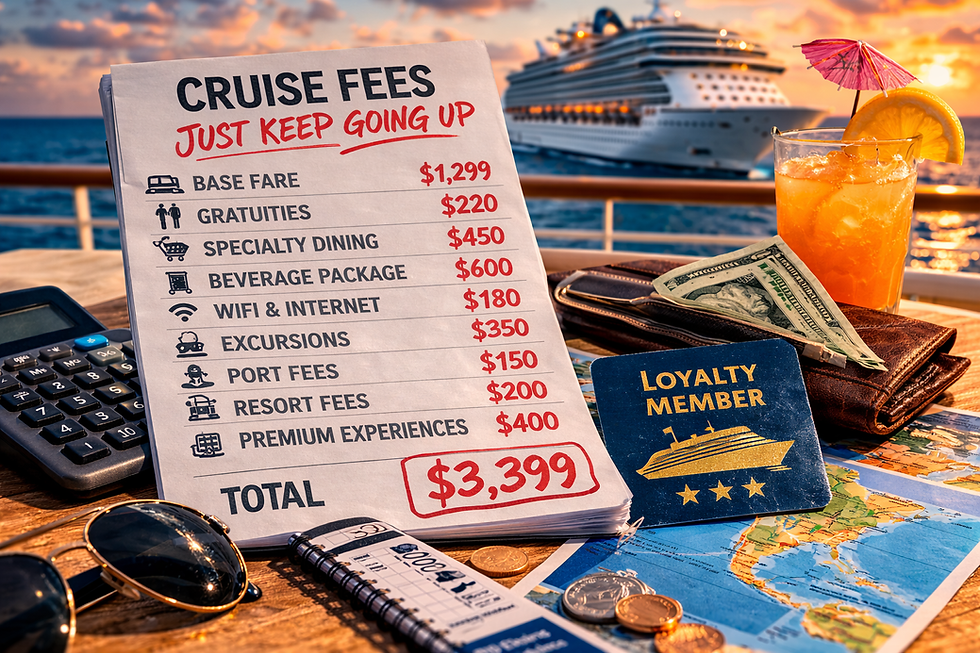
amenities all come with added costs. Gratuities have risen steadily, port fees continue to climb, and even previously complimentary services are increasingly bundled into paid packages.
From a business perspective, this strategy makes perfect sense. Cruise lines endured billions of dollars in losses during the pandemic and took on significant debt to survive. Recapturing that financial stability requires strong revenue streams, and onboard spending has become one of the most reliable ways to generate profit.
But there is also a broader industry trend at play—one that mirrors the evolution of another entertainment giant: Las Vegas.
Decades ago, Las Vegas was known for inexpensive rooms, cheap buffets, and free drinks designed to attract visitors. The casinos made their money on gambling, so everything else was positioned as a value-driven incentive. Over time, that model shifted dramatically. Today, nearly every aspect of the Vegas experience has become a profit center—from resort fees and premium dining to ticketed entertainment and exclusive experiences.
The cruise industry appears to be following a similar trajectory.
Ships are increasingly designed not just as transportation and accommodation, but as fully integrated entertainment platforms where every activity represents a potential revenue opportunity. What once felt like an all-inclusive vacation is now evolving into a layered pricing model where the base fare is simply the starting point. And yet, travelers continue to book.
As long as ships sail full and demand remains strong, there is little incentive for cruise companies to change course. Businesses respond to market behavior, and right now the market is telling them that customers are willing to pay for these added experiences.
Loyalty programs reinforce this dynamic. Cruise lines reward repeat passengers with perks, priority access, and status tiers that encourage continued brand allegiance. Much like airline miles or coffee rewards programs, these systems create a psychological investment. Once travelers have accumulated status, many feel reluctant to switch brands—even if prices rise.
But loyalty should always work both ways.

Consumers benefit from remembering that travel is ultimately about personal value. If pricing structures begin to outweigh the perceived benefits, travelers still have choices. Competing cruise lines, alternative vacation styles, and entirely different travel experiences are always available.
At some point—just as Las Vegas discovered—an industry can push pricing too far. The balance between value and profit is delicate. When that balance tips too heavily toward squeezing every dollar from the customer, the market eventually responds.
Until then, the cruise industry will continue doing exactly what successful businesses do: capitalizing on demand.
The best strategy for travelers is simple—be loyal not to a brand, but to your own expectations, priorities, and budget.


Comments