Dresden, Completely Destroyed

Walking through Dresden today, it is difficult to imagine just how much of this beautiful historic city was destroyed during World War II. Everywhere you look, there are magnificent churches, palaces, museums, and public squares. Yet much of what appears centuries old has actually been painstakingly reconstructed after the devastation of the war.
In February 1945, British and American bombers carried out a series of massive air raids on Dresden. The bombing and resulting firestorm destroyed much of the historic city center and killed approximately 25,000 people. The bombing remains one of the most debated Allied air operations of World War II.
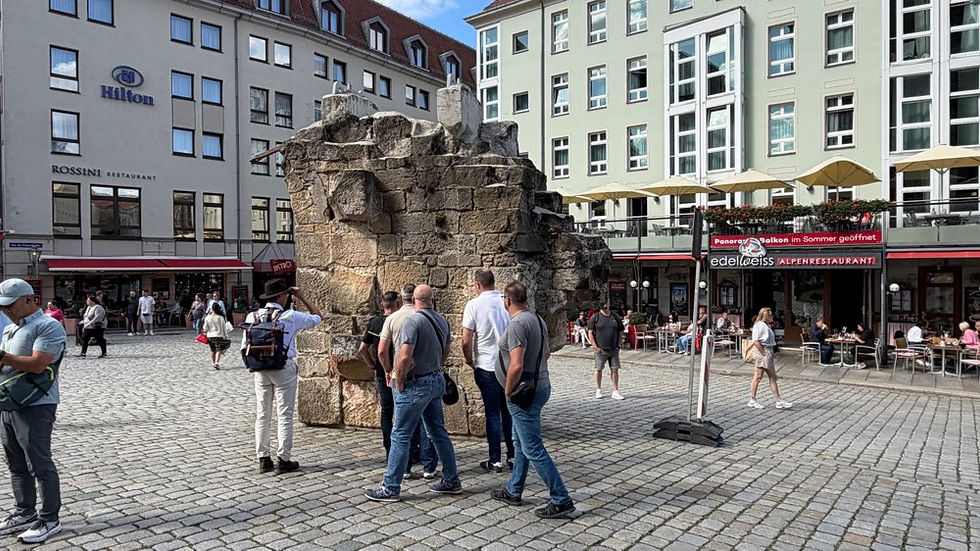
One of the most recognizable symbols of Dresden’s destruction and rebirth is the Frauenkirche, or Church of Our Lady. The original church stood for approximately two centuries before collapsing following the 1945 bombing. Its ruins remained in the center of Dresden for decades, particularly during the years when the city was part of communist East Germany.

After German reunification, an enormous reconstruction effort began. Wherever possible, original stones recovered from the ruins were incorporated into the new structure. You can actually see some of these darker stones mixed among the newer, lighter-colored stone. The reconstructed church was finally completed and reconsecrated in 2005. Standing in front of it today, knowing what happened here, makes the building much more than simply another beautiful European church. It represents the rebuilding of an entire city.
We also explored Dresden’s Royal Palace, which was once the residence of the rulers of Saxony. One of the most famous was Augustus the Strong, who ruled Saxony and also became King of Poland. The palace suffered tremendous damage during the 1945 bombing, and restoration has continued for decades. Today, portions of the palace house museums and collections that help tell the story of Saxony’s rulers and Dresden’s long history.

Another impressive stop was the Zwinger Palace. Originally created during the reign of Augustus the Strong, its courtyards and gardens were designed as an elaborate setting for royal festivities, ceremonies, and entertainment. Today, instead of entertaining kings and their guests, the complex houses museums and an important art collection. Walking through the courtyard, it isn’t difficult to imagine the elaborate events that once took place here.

The history of Dresden during the East German period is equally interesting. After the war, reconstruction priorities under the German Democratic Republic were very different from those following reunification. Some historic structures were restored, while others remained damaged or were left as ruins. Since reunification in 1990, enormous resources have been devoted to restoring Dresden’s historic center.
And then there was a completely different piece of East German history—the Trabant. We stopped in a store where we found one of these classic East German cars on display. The Trabant, affectionately known as the “Trabi,” became one of the most recognizable symbols of everyday life in East Germany.

Compared with modern cars, it is incredibly small and basic, but seeing one in person was a fun reminder that history isn’t only found in palaces, churches, and museums. Sometimes it is sitting inside an old automobile.
Dresden is a fascinating combination of destruction, survival, reconstruction, and remembrance. Walking its streets today, you are not simply looking at beautiful buildings. You are seeing a city that has spent decades rebuilding its connection to its own past.


Comments