
Today was a day I have thought about for a very long time.

Updated: 2 days ago
As a Jewish person, I have always felt a need to visit a concentration camp, not because I expected it to be easy, but because there are some places where I believe you need to stand and confront history for yourself. Today, I visited Buchenwald.
Located on the Ettersberg mountain above Weimar, Buchenwald concentration camp was established by the Nazis in 1937 and operated by the SS. More than 200,000 people from across Europe would eventually be imprisoned here: political prisoners, Jews, Roma and Sinti, prisoners of war, religious prisoners, and many others the Nazi regime considered enemies.
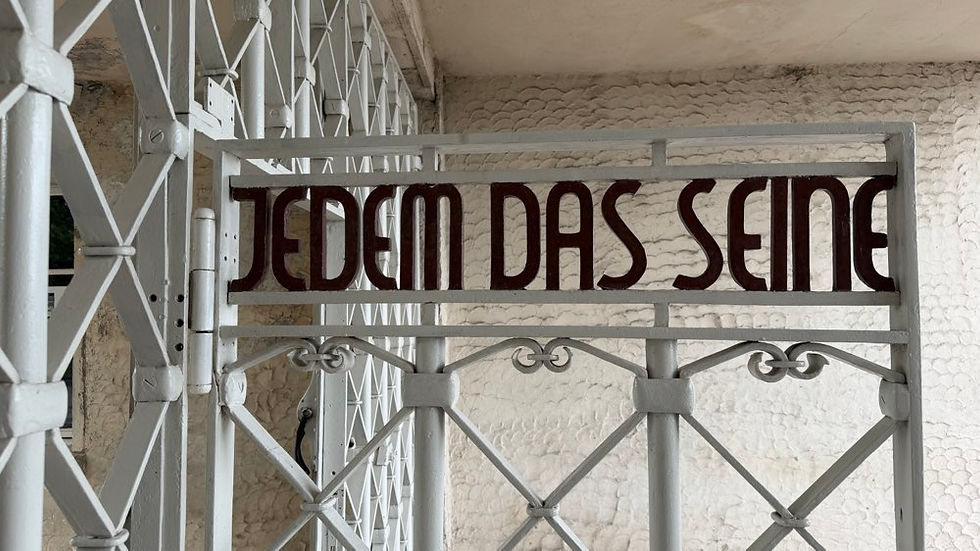
Walking through the same gate prisoners entered was sobering. On the other side of this gate was the parade ground where thousands of prisoners stood for hours performing the same mundane tasks over and over just for the entertainment of the guards

The barbed-wire fence is still there. The guard towers are still there. The camp had a zoo built by the prisoners

Immediately beside the gate is the detention building known as the “Bunker,” the camp prison and one of its most notorious places of torture.

I stood alone in the hallway between those small cells. The rooms are tiny. It is difficult to describe what it feels like to stand there knowing human beings were confined, tortured, and sometimes killed within those walls.
For a moment, history no longer felt like something from a textbook.
It felt very close.
Then came the crematorium.
That was probably the most difficult part of the visit for me. Bodies were brought into the pathology area,

where gold teeth were removed before the dead were cremated. The basement was also used for executions.
Standing there and then seeing the ovens is something I will not soon forget.

New prisoners arriving at Buchenwald were stripped of their clothing and possessions. Their hair was shaved, and they were subjected to a painful disinfecting process.

It was part of a deliberate system that stripped people not only of their possessions, but also of their dignity and individuality.
I also walked past the SS dog kennels. The dogs were trained as guard dogs, used to terrorize prisoners and pursue those who attempted to escape.

Then there was the “Small Camp,” a quarantine section that became horrifically overcrowded as prisoners were transported into Buchenwald during the final months of the war. Thousands of exhausted and starving prisoners were packed into primitive barracks as the Nazi concentration camp system collapsed around them.
Toward the end of the war, the SS began evacuating Buchenwald and its sub camps, forcing thousands of prisoners onto evacuation transports and death marches.
You can read about all of this.
You can teach it.
You can watch documentaries and look at photographs.
But there is something very different about standing there.
Standing inside a cell.
Walking along the barbed wire.
Looking up at a guard tower.
Standing inside the crematorium.
I spent years teaching and reading history. The Holocaust and Nazi Germany were subjects I taught, studied, and understood academically. As a Jew, this history has also always carried a cultural and personal meaning that went far beyond a classroom.
Today, those two parts of my life came together.
For a few hours, I stood in one of the places where that history actually happened. No textbook, photograph, documentary, or classroom discussion could completely prepare me for that.
I don’t know that I will ever completely understand what I felt today.
Maybe that is the point.
Some places aren’t meant to leave you with answers.
They are meant to make sure we never stop asking how human beings allowed this to happen—and how we make sure it never happens again.


Comments