
Nagasaki: A Place of Destruction, Remembrance, and Hope

Visiting Nagasaki was one of the most sobering experiences of my trip to Japan. Today, it is a modern, green, and welcoming city, with trams gliding quietly through its streets and children’s voices drifting from schoolyards. Yet within the Peace Park and the Atomic Bomb Museum, there are spaces where time seems to slow, and the memory of a single morning in 1945 presses heavily against the present.
At 11:02 a.m. on August 9, 1945, an atomic bomb detonated approximately a quarter of a mile above Nagasaki. In an instant, a blinding flash was followed by a violent wave of heat and wind that tore through the city. An inferno consumed entire neighborhoods. An estimated 73,884 people died, and another 74,909 were injured. Nagasaki’s population at the time was only about 200,000. These numbers are staggering on paper, but standing among the exhibits, seeing melted glass, charred fragments of everyday life, and photographs of streets reduced to ash, made the scale of loss feel painfully immediate and human.
The Fountain of Peace stands as a quiet, sorrowful tribute to one of the bombing’s most haunting

realities. In the aftermath, many survivors wandered through smoke and rubble, their skin burned, their throats parched, calling out for water. The city’s clean water supply had been destroyed; what remained was often tainted with oil, debris, and ash.
The fountain now flows in a gentle, continuous arc, its sound soft and steady, as if trying to soothe an absence that can never be fully healed. It honors those final desperate moments while offering an ongoing prayer for peace.
Not far away rises the Nagasaki Peace Statue, large and still against the sky. Its right arm points upward, indicating the threat of nuclear weapons and the direction from which the bomb came. Its left arm extends outward, open and steady, as if offering both warning and embrace. The figure’s closed eyes give it a solemn, meditative expression, as though it is silently mourning and praying at once. There is a quiet strength in its posture—a plea that Nagasaki remain the last city to endure such devastation.

Across the park, thousands of paper cranes hang in clusters or rest gently on stone surfaces. Some are faded by sun and rain, others still vivid in color. In Japanese tradition, the crane symbolizes hope, healing, and peace. Here, they feel deeply personal, each one folded by a hand carrying intention, grief, or prayer. Together, they create a fragile but persistent chorus of remembrance, their colors softening the weight of the surrounding history.
Scattered throughout the area are ruins that mark the reach of the blast.

The remains of a prison stand roughly three-quarters of a mile from the hypocenter, its broken structure still bearing the imprint of sudden force. Half a mile away, parts of Urakami Cathedral survived amid near-total
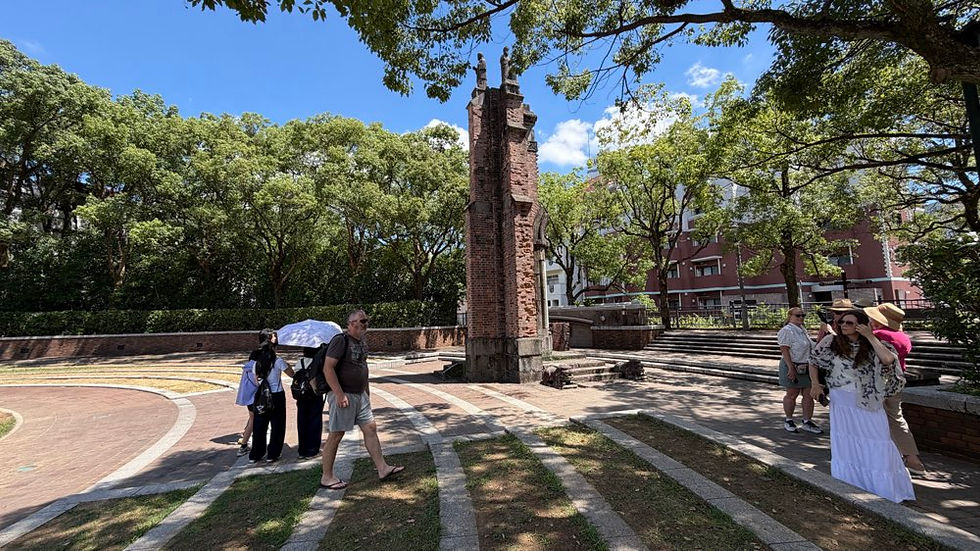
destruction, its damaged walls a stark reminder of what was lost. A concrete torii gate stands partially

shattered, its fractured form frozen in place. Looking at these remnants, it is difficult not to imagine the overwhelming pressure of heat and wind that swept through the city in seconds, reshaping everything in its path.
At the center of it all, the hypocenter has been transformed into a quiet, open space. The original crater has long since been filled, and the surrounding area carefully rebuilt. Historical photographs show a landscape once stripped bare, unrecognizable in its devastation. Today, the site is calm with trees,
pathways, and stone markers arranged with care. That calmness, however, is what makes the contrast so striking. Beneath the stillness lies a history that refuses to fade. It is a reminder that such destruction is not abstract or distant; it has happened, and it can happen again.
The entrance to the Nagasaki Atomic Bomb Museum is especially powerful in its design. The walkway descends in a slow spiral, drawing visitors downward as if moving backward through time toward 11:02 a.m.

The air grows quieter as one approaches the exhibits. Inside, a full-scale replica of the atomic bomb hangs suspended, stark and unadorned, its presence unsettling in its simplicity. Around it, photographs, scorched objects, and personal belongings—watches stopped at the moment of the blast, lunch boxes fused by heat, fragments of clothing—speak in a language more immediate than statistics. Survivor testimonies, written and recorded, carry voices that are steady yet heavy with memory.

This is not an easy place to visit, nor should it be. The museum and memorials do more than preserve history; they confront visitors with the human reality behind it. They ask for attention, reflection, and responsibility in the face of what war can do.
And yet, Nagasaki does not end in despair. The Peace Statue, the flowing water of the fountain, and the thousands of folded cranes all insist on something more enduring than destruction. They suggest that remembrance is not passive, it is a commitment. We remember not only to honor those who were lost, but to carry forward a hope that such loss will never be repeated. In that way, Nagasaki stands as both a wound and a warning, but also as a quiet, persistent promise.


Comments