Mycenae + Epidaurus: The Day Greece Starts Feeling Like Myth

Walking Into Homer’s World
When you read the Illiad in school, it can feel distant—names like Agamemnon, stories of kings, wars, and gods. But then there’s a moment in Greece when those stories stop feeling like mythology and start feeling real.
That moment happened the day I stepped into Mycenae, I was no longer just reading about ancient heroes—I was standing where that world was built.
Mycenae: Power, Gold, and the Birth of Greek Civilization
Mycenae isn’t just another ruin, it was one of the most powerful centers of the Mycenaean civilization, dominating Greece from roughly 1600–1100 BC. Long before Athens reached its peak, this was a hub of political power, military strength, and royal authority tied to the legends of the Trojan War.
What to Notice
Lion Gate: Europe’s oldest monumental sculpture, two lions symbolizing dominance
Cyclopean Walls: Massive stones so large ancient Greeks believed only giants built them
Hilltop Layout: A strategic citadel designed for defense and visibility
Palace Complex: The political and ceremonial heart at the summit
Tholos Tombs: Advanced engineering hidden just beyond the main site
The Lion Gate sets the tone immediately. It’s not decorative—it’s psychological. You feel like you are entering a place designed to project control and intimidate outsiders.

Inside, the “castle ruins” are far more than scattered stones. With context, you begin to see a functioning system: governance, defense, and daily life all layered into a single elevated stronghold.

The Treasury of Atreus: Engineering Before Its Time
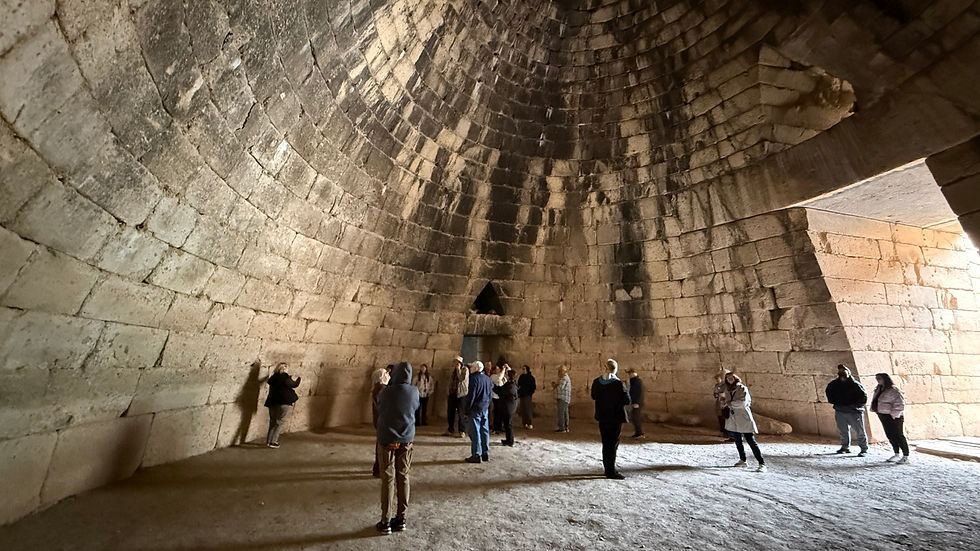
Just outside the citadel sits the Treasury of Atreus, often called a beehive tomb. It’s one of the most impressive architectural achievements of the ancient world.
A long, narrow passage leads you into a massive domed chamber built entirely of stone—no modern tools, no mortar, just precision. The scale is unexpected, and the acoustics subtly echo your footsteps. It’s believed to be a royal burial site, possibly tied to the legendary House of Atreus.
Myth vs. History (Quick Reality Check)
Myth: Agamemnon ruled here exactly as described in epic poetry
History: Mycenae was a real, powerful Bronze Age city that likely inspired those stories
Takeaway: Myth and history overlap—but they are not the same
Museum Highlights
The nearby museum completes the picture:
Gold burial masks (including the so-called “Mask of Agamemnon”)
Weapons and artifacts from elite graves
Models that reconstruct how the citadel once looked
Epidaurus: Where Ancient Design Becomes Magic
After Mycenae, the experience shifts as we arrived at Epidareous . Where Mycenae is about power, Epidaurus is about perfection.
The Theater That Shouldn’t Work (But Does)
The ancient theater holds around 14,000 people, yet a whisper from the stage can be heard at the very top. No microphones. No technology. Just design and geometry working in harmony with nature.

Lego Man Tests the Acoustics
Lego Man steps onto the stage, leans forward, and whispers a single line: “Science.” From the top row, it’s crystal clear. He nods confidently. Experiment complete.

A Sensory Moment
You sit on warm stone worn smooth by thousands of years. A light breeze moves through the open hillside. Someone drops a coin on the stage—it echoes upward, sharp and precise. The symmetry pulls your eye outward, row after row, perfectly aligned. You’re not just observing history—you’re inside it.

Why It Feels Different
Epidaurus isn’t just preserved—it’s functional. The design still works exactly as intended, connecting architecture, sound, and human experience in a way that feels surprisingly modern.
Why This Day Changes Everything
Most travelers think Greece is about Athens landmarks or island views. But this day shifts your perspective:
Mycenae shows where Greek civilization began
Epidaurus shows how advanced it became
Together, they bridge myth and reality.
The Travel Advisor Perspective: Why a Guide Matters
Here’s the practical takeaway: this is a day where a guide makes a measurable difference.
Without context:
Mycenae = ruins
Epidaurus = an old theater
With a guide:
Mycenae = political power, engineering, and mythological influence
Epidaurus = acoustic mastery and intentional design
Final Takeaway
If Athens is where you learn about Greece,
then Mycenae and Epidaurus are where you feel it.
This is the day Greece stops being a destination…
and starts becoming a story you’re walking through.


Comments